The Tudors Historical Inaccuracies Season 1
Jump to navigation
Jump to search

◄ Back home: <a href="/" target="_self">The Tudors Fan Wiki</a> See also: The Tudors Depictions Throughout History | The Tudors Photos | The Tudors 100 Reasons to Watch

 FACT OR FICTION? History buffs! Have you sniffed out a few historical inaccuracies within The Tudors drama? Whether minuscule or huge, catalogue them here to see how the show sizes up against British history. (Brief descriptions please - for more lengthy in-depth history see characters profiles and other individual pages on Site Map) Season 1
| |
 |
| According to The Tudors | According to History | |
| Event or Person | Cardinal Wolsey commits suicide while in prison.  Episode #1 : 10 Episode #1 : 10 | Cardinal Wolsey died around the age of 60. of an illness en route to London at Leicester Abbey, to answer the charges of treason held against him. Year: 29th November, 1530. |
Henry Fitzroy dies at a very young age from sweating sickness. Episode #1 : 5 |  Henry Fitzroy was married at age 14 to Mary Howard, cousin of Anne Boleyn. He actually died 3 days after his 17th birthday, on June 18th 1536, after Anne Boleyn was executed and Henry VIII was married to Jane Seymour. Henry Fitzroy died of consumption (tuberculosis), the same illness that would kill Henry's only surviving, legitimate son, Edward VI. Henry Fitzroy was married at age 14 to Mary Howard, cousin of Anne Boleyn. He actually died 3 days after his 17th birthday, on June 18th 1536, after Anne Boleyn was executed and Henry VIII was married to Jane Seymour. Henry Fitzroy died of consumption (tuberculosis), the same illness that would kill Henry's only surviving, legitimate son, Edward VI. | |
Princess Mary Tudor, the daughter of Henry VIII & Katherine of Aragon is seen at the Field of Cloth of Gold meeting her betrothed, the Dauphin of France and pushing him over | The princess Mary mentioned was not Henry VIII's daughter (later Queen Mary I). She did not accompany her parents to France for this event despite her betrothal to the dauphin of France. Instead it was Henry's sister, also called Mary, who was mentioned in contemporary accounts. This Mary certainly attended the Field of Cloth of Gold. | |
King Henry VIII has one sister, Princess Margaret.  |  King Henry VIII had two sisters, Princess Margaret and Princess Mary. The character in the series is an amalgam of the two sisters to avoid confusing the king's daughter with the king's sister. Neither Mary nor Margaret was married to the King of Portugal (let alone murdered him). Mary was married to the King of France and later to Charles Brandon, becoming the ancestress to Lady Jane Grey, the 9-day queen. Margaret was married to the King of Scotland and was the ancestress to Mary Queen of Scots. King Henry VIII had two sisters, Princess Margaret and Princess Mary. The character in the series is an amalgam of the two sisters to avoid confusing the king's daughter with the king's sister. Neither Mary nor Margaret was married to the King of Portugal (let alone murdered him). Mary was married to the King of France and later to Charles Brandon, becoming the ancestress to Lady Jane Grey, the 9-day queen. Margaret was married to the King of Scotland and was the ancestress to Mary Queen of Scots. | |
Princess Margaret travels to Portugal to marry the aging King of Portugal. Episode #: 1.4 1.4 |  It was Mary (at age 18) that traveled to France (not Portugal) to marry the aging King Louis XII (age 52). It was Mary (at age 18) that traveled to France (not Portugal) to marry the aging King Louis XII (age 52). Princess Margaret married James IV of Scotland. Year:1514 (Mary's marriage to Louis) | |
Princess Margaret kills the King of Portugal. Episode #: |  King Louis XII of France died three months after marrying Princess Mary, of natural causes (believed he wore himself out trying to produce an heir with Mary). She then married Charles Brandon. Year: 1515 King Louis XII of France died three months after marrying Princess Mary, of natural causes (believed he wore himself out trying to produce an heir with Mary). She then married Charles Brandon. Year: 1515 | |
| There is no mention of Princess Margaret and Charles Brandon having any children. Episode # 1: NOTE: It is shown that she is pregnant but in a deleted scene. Note: During a conversation w/ Henry about his interest in (future wife to be) Catherine Willoughby, Charles remarks that his "young son" (referring to his child with the deceased Princess Margaret) is in need of a mother~ to which Henry jests about Catherine's young age of 17. Though in reality, Catherine was a mere 15 when they married, (perfectly suited for motherhood in Tudor times)- and Catherine was Charles' 4th wife (he was 50 at the time of his marriage to her), so any children she became stepmother to belonging to Mary would be much older. It's also stated elsewhere that Catherine was actually betrothed to Charles' son with Mary Tudor, but forwent the betrothal in favour of marrying her himself when his 3rd wife pas  sed. sed. | Princess Mary and Charles Brandon had three children during their marriage. By re-writing history, The Tudors wrote out the existence of Lady Jane Grey, the descendant of Mary, Henry's younger sister, an important historical character, as well as Mary, Queen of Scots -- an essential historical character and the descendant of Margaret, Henry's older sister. Of course, without Mary, Queen of Scots, her son James wouldn't have existed either, who reigned after Elizabeth I, from 1603 to 1625. Year: Henry (1516), Frances (1517), Leonor (1519). Note: Frances Brandon married Henry Grey (1551 became 1st Duke of Suffolk) and had three daughters (Lady Jane Grey, Lady Catherine Grey, and Lady Mary Grey). Lady Jane Grey would end up being "Queen Jane" for only nine days before Mary took the throne. | |
 |  There is no known record of this affair and highly unlikely considering Princess Marguerite's well respected reputation. There is no known record of this affair and highly unlikely considering Princess Marguerite's well respected reputation. | |
King Henry VIII has an affair with Mary Boleyn only briefly on The Tudors. In Season 2, Mary says that her husband William Carey was impotent and made no mention of the considerable posthumous debts he left her. Episode #: 1.2, 2.2 | In actuality, no ones knows how long King Henry VIII was with Mary. She is never mentioned in contemporary reports and we only know of her because of the dispensation Henry got when he wanted to marry Anne, her sister, which meant he slept with Mary. It is more likely that the affair was brief. Most historians do not believe he fathered two children with her, Catherine and Henry. The children were claimed by William Carey. Many historic and modern figures claim Mary Boleyn as an ancestor, including Queen Elizabeth II, Charles Darwin, Winston Churchill, and Lady Diana Spencer, the former Princess of Wales. At his death in 1528, Mary's first husband left her with massive debts. It was Anne who came to her aid -- she arranged for her nephew to be educated at a Cisterean monastery and secured for her sister an annual pension of 100 pounds. Mary and William's children: Henry Carey (b.1526), Catherine Carey (b.1524) For more see: Mary Boleyn controversies | |
Anne Boleyn has blue eyes & is fair skinned. She is quite beautiful. Episode #: All |  Anne Boleyn was renowned for her dark, nearly black eyes & olive skin. Anne Boleyn was generally not referred to as beautiful in her day (although Francis I called her "Venus" and a venetian ambassador called her "beautiful") except for her eyes, which were considered beautiful and which she knew how to use. Some writers of the time disparaged her physical appearance, but as it has been said, such an ugly, unattractive woman would hardly have caught the King's eye and held his attention all those years. Perhaps one of her attractions for Henry was her education. She had an extensive education which normally would have been reserved for a royal princess being groomed to marry extremely well. Most girls of Anne's social status could barely write their own names. Anne Boleyn was renowned for her dark, nearly black eyes & olive skin. Anne Boleyn was generally not referred to as beautiful in her day (although Francis I called her "Venus" and a venetian ambassador called her "beautiful") except for her eyes, which were considered beautiful and which she knew how to use. Some writers of the time disparaged her physical appearance, but as it has been said, such an ugly, unattractive woman would hardly have caught the King's eye and held his attention all those years. Perhaps one of her attractions for Henry was her education. She had an extensive education which normally would have been reserved for a royal princess being groomed to marry extremely well. Most girls of Anne's social status could barely write their own names.NOTE: the contemporary writers who described Anne as ugly were either affiliated with the Spanish, the Emperor Charles V, or her enemies within the English court. To those who loved her she was "handsome", "sweet and cheerful." To her enemies she was "the goggle eyed wh*re". Year: N/A | |
| The series shows Anna Buckingham, the daughter of Edward Stafford, 3rd Duke of Buckingham having an affair with Charles Brandon, 1st Duke of Suffolk. Later she is called Anna Hastings and is shown as living with Sir William Compton and dying of the sweating sickness after he dies.  | Her name was actually Lady Anne Stafford, Lady Hastings, wife of the Earl of Huntingdon, and she was the sister of the Duke of Buckingham, not his daughter. The rumoured affair in 1510 was with King Henry VIII himself and Sir William Compton was suspected of being the go-between. However, it seems she probably did later have an affair with Compton because in 1522 he put her in his will to receive lands. Buckingham subsequently caught Sir William Compton in Anne’s chamber. After a heated exchange during which Buckingham is reported to have told the pair that 'women of the Stafford family are no game for Comptons, no, nor for Tudors, either', the Duke saw to it that Anne’s husband spirited his wife away from court. She died c. 1544 after having 8 children. | |
Richard Pace, the King's secretary is framed by Cardinal Wolsey & sent to the tower, where he goes mad. Episode #1:4 | Pace was well respected, and was on the continent as Wolsey's agent at this time. There is no historical reference of him being sent to the Tower. It is recorded that he had an illness & died in 1536. | |
Musician Thomas Tallis joins the Chapel Royal very early in his life and career. Episode #: 1 | Thomas Tallis joined the Chapel Royal in his mid- to late-thirties. (His birth date is unknown; best guess is sometime between 1505 and 1510.) It is true that he went right from Canterbury Cathedral to the Chapel Royal, but prior to his brief stay in Canterbury, he had held appointments at Dover Priory; St. Mary-at-Hill, Billingsgate; and Waltham Abbey. Year: c. 1543 | |
Thomas Tallis has a tragically brief romance with Sir William Compton. Episodes #: 5-7 |  There is no solid information on Tallis' personal life until the year 1552, when his 33-year marriage commenced. Practically no chance he ever met William Compton, let alone fell for him. There is no solid information on Tallis' personal life until the year 1552, when his 33-year marriage commenced. Practically no chance he ever met William Compton, let alone fell for him. | |
Elizabeth (Bessie) Blount was married when she conceived Henry FitzRoy. Episode #:1 | Bessie Blount delivered Henry FitzRoy in 1519 but did not marry Gilbert Tailboys (a marriage arranged by Henry VIII himself) until 1522. Year: 1519, 1522 | |
Anne Boleyn has no suitors other than Thomas Wyatt |  Anne Boleyn and Henry Percy wanted to marry, and were in love, but Percy was betrothed to Lady Mary Talbot instead. James Butler was another suitor. In fact, Anne was recalled from the French court in late 1521 by her father in hopes that a marriage with their Butler relatives would settle a family dispute over the inheritance of the Irish peerage of Ormonde. For unknown reasons, the issue stagnated over many years and the marriage never materialized. Year: Around the early 1520s Anne Boleyn and Henry Percy wanted to marry, and were in love, but Percy was betrothed to Lady Mary Talbot instead. James Butler was another suitor. In fact, Anne was recalled from the French court in late 1521 by her father in hopes that a marriage with their Butler relatives would settle a family dispute over the inheritance of the Irish peerage of Ormonde. For unknown reasons, the issue stagnated over many years and the marriage never materialized. Year: Around the early 1520sFor more see : Anne Boleyn Controversies | |
| Henry VIII has no beard. Episode# 1: all Note: Season 2 - he has a beard   | Henry VIII's beard was an in-today-out-tomorrow kind of thing until he began having trouble with Anne Boleyn. She hated him with a beard, so he wore it for the rest of his life. It has also been said that in May of 1535 Henry decided to grow a beard in the same style as Francis I. Year: 1520 Note to above: It was Anne who liked him with a beard; Katherine did not. In fact, there is a funny anecdote that Henry said he would not shave his beard until he met Francis again, but then he found out Katherine did not like his beard, so he shaved it off! He almost caused a war because of the love he had for Katherine! | |
| Katherine of Aragon *Historians have spelled Katherine’s name numerous ways over the years. Katherine herself spelled her name variously with a C or K. The producers of the series have chosen to spell it with a K and with regards to keeping our links working, the wiki has used this spelling.[[Queen Katherine of Aragon|  ]] ]] | 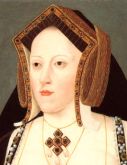 Catherine of Aragon's name- and it's proper spelling- has been contested for quite some time. The root of the confusion stems from two places: 1) She was born, and christened in Spain, where she was given the name "Catalina de Aragon y Castilla" (her parents were Isabell {Ysabel} I of Castile, & Ferdinand II of Aragon). 2) Catherine, having been groomed in the English ways from the point of betrothal to Arthur Tudor (estimated to be at age 2) as part of her preparation to be queen. After her arrival in England, she changed her name to the Anglicized "Katherine", in order to better fit her role as the Queen of England. Never the less, "Catalina" signed her name as both "Catherine" and "Katherine" intermittently throughout her reign. Some have suggested this was simply poor translation of historical annuls, but there is concrete documentation in Catalina's own hand signed as both starting with a C and a K. | |
Wheeled carriages are used by the court | People traveled on horseback or in litters, not wheeled carriages. They were not used until the 17th century. *NOTE TO POSTING: On one hand, I can not assure they traveled "on wheels", but carriages with wheels appeared at least in ancient Mesopotamia bet. the years 3.500 bc and 3.000 bc. There are no contemporary descriptions of a litter on which to go on, therefore film and TV are left to make an artistic choice. The inaccuracy has more to do with the type of carriages depicted, not whether they were used as conveyances. As a practical matter, carriages weren't used much for human transportation (especially the nobility) because springs and leather slings weren't in use during the period depicted. As a result, they were VERY uncomfortable to ride in. The carriages used in the series are 18th- (perhaps late 17th-) century vehicles. The post above is correct in that there were no wheeled “carriages” in 16th-century England. However, there was a wheeled vehicle sometimes used by the aristocracy for travel. It was called a whirlicote, also sometimes called a chariot. Think of it as a large rendition of a child’s wagon (no springs or suspension of any kind), sometimes covered with a top, with the horses led or ridden rather than driven from the vehicle. **NOTE TO ABOVE: "The carriages used in the 1st series are 18th- (perhaps late 17th-) century vehicles." No, they were late 19th C vehicles, since they not only had C springs but also had rubber tyres and glass windows. They were nothing like "a whirlicote, also sometimes called a chariot." They were almost as much of an anachronism as a steam engine or a Ferrari would have been! | |
Princess Mary Tudor still looks 6 in 1528 | Princess Mary was 12 in 1528 | |
Anne Boleyn is referred to as "Lady Anne" when she and her sister are still at the French court in Episode 2, and also when she first appears at Henry's court. In later episodes, she is sometimes referred to as Mistress Boleyn | When Anne was at the French court and later when she made her first appearance at Henry's court, her proper title would have been Mistress Boleyn. She did not become "Lady Anne" until her father was created Lord Rochford, at which point it would have been incorrect to refer to her as Mistress Boleyn. | |
In Episode 1 Henry's uncle "Courtenay" is murdered in Rome by French agents. Episode #1:1 | Henry didn't have an uncle. His father Henry VII was an only child, and his mother's two brothers, the famous Princes in the Tower, disappeared in 1483. It is generally presumed that they were murdered by Richard III. However, William Courtenay was married to Henry's Aunt Katherine of York. He died of pleurisy in 1511 (4.7 years before Princess Mary was born). He was never the ambassador to Italy. Note: Henry did have an uncle; Arthur Plantagenet, Viscount Lisle. He was the acknowledged illegitimate son of Edward IV. Also, his aunt's husband is still his uncle, just not by blood. However, the murder is definitely made up. TRUE CAUSES OF THE WAR AGAINST FRANCE The war against France in 1512–14 was the most significant opportunity for Cardinal Wolsey to demonstrate his talents in the foreign policy arena. The justification for going to war came in 1511 in the form of a plea for help from <a class="external" href="http://en.wikipedia.org/wiki/Pope_Julius_II" rel="nofollow" target="_blank" title="Pope Julius II">Pope Julius II</a>, who was beginning to feel threatened by France. England formed an alliance with the Pope, <a class="external" href="http://en.wikipedia.org/wiki/Ferdinand_V_of_Spain" rel="nofollow" target="_blank" title="Ferdinand V of Spain">Ferdinand V of Spain</a>, and <a class="external" href="http://en.wikipedia.org/wiki/Maximilian_I,_Holy_Roman_Emperor" rel="nofollow" target="_blank" title="Maximilian I, Holy Roman Emperor">Maximilian I, Holy Roman Emperor</a> against <a class="external" href="http://en.wikipedia.org/wiki/Louis_XII_of_France" rel="nofollow" target="_blank" title="Louis XII of France">Louis XII of France</a>. The first campaign against France was not a success, partly due to the unreliability of the alliance with Ferdinand. Wolsey learned from the mistakes of the campaign, however and, in 1513, still with papal support, launched a joint attack on France, successfully capturing two French cities and causing the French to retreat. Wolsey's ability to keep a large number of troops supplied and equipped for the duration of the war was a major factor in its success. Wolsey also had a key role in negotiating the Anglo-French treaty of 1514, which secured a temporary peace between the two nations. Under this treaty, the French king, <a class="external" href="http://en.wikipedia.org/wiki/Louis_XII" rel="nofollow" target="_blank" title="Louis XII">Louis XII</a> would marry Henry VIII's younger sister, Mary. The wedding took place on October 9, 1514. Mary, age 18, was married to the 52-year-old King Louis XII at <a class="external" href="http://en.wikipedia.org/wiki/Abbeville" rel="nofollow" target="_blank" title="Abbeville">Abbeville</a>. The wedding was 16 months BEFORE Princess Mary, Henry's daughter, was born. | |
Anne Boleyn is the muse who inspires many of Thomas Wyatt's greatest poems, including "And wilt thou leave me thus?" and "They flee from me. that sometime did me seek." Episode # 1:  | Actually Wyatt loved quite a few women. Only a couple of his poems are generally accepted by scholars as having been inspired by Anne Boleyn. One is the famous "Whoso list to hunt" (an adaptation of a sonnet by Petrarch) . The other refers to Anne as "Brunet, that did set my wealth in such a roar." Originally the line was "Brunet, that did set our country in such a roar," but Wyatt changed it to make the allusion to Anne less obvious. *See Thomas Wyatt's Poetry page on the wiki | |
| King Henry is shown playing chess with Sir Thomas Boleyn, Earl of WIltshire and asking about the king of France, particularly his legs. Episode:  | This conversation never happened with Sir Thomas Boleyn, but in fact with a Venetian Ambassador Pasqualido in 1515. | |
Queen Claude of France is a beautiful woman who catches the eye of the philandering Charles Brandon in 1528. |  The real Queen Claude was quite unattractive, had scoliosis, and died in 1524. Charles Brandon did flirt with Margaret of Austria, regent of the Low Countries, while Anne Boleyn was serving as a maid of honor, but it is doubtful they shared any sexual intimacy. The real Queen Claude was quite unattractive, had scoliosis, and died in 1524. Charles Brandon did flirt with Margaret of Austria, regent of the Low Countries, while Anne Boleyn was serving as a maid of honor, but it is doubtful they shared any sexual intimacy. | |
In one of the early episodes Thomas Boleyn is referred to as being from "an old family." | In fact, the Boleyns were parvenus who married well. Thomas Boleyn's wife Elizabeth was the Duke of Norfolk's sister; hence his alliance with the Howards. | |
Henry seems still to be quite young when he first becomes infatuated with Anne Boleyn, while his wife Katherine is well into her middle years. | In fact, Henry was well into his thirties when he fell for Anne. Katherine was 6 years older than Henry, making her about 40 at the time. As for Anne, she may have been in her late teens or mid-twenties depending on whether you accept 1501 or 1507 as her year of birth. | |
George isn't really mentioned, although he and Anne were very close in season 1. His marriage isn't mentioned either. EDIT: His marriage to Jane Parker is depicted in Episode #2:7, including a rape scene after their marriage . . | Anne's brother George was actually married to Jane Parker before Henry fell for Anne. While a rape can be disputed, Jane Parker was the historic character who testified against George and Anne, claiming the two had a sexual relationship. | |
 |  Katherine of Aragon had red-gold hair and blue eyes, as she had English ancestors. Her great grandmother was Katherine of Lancaster, and was the great-great- great granddaughter of <a class="external" href="http://www.royal.gov.uk/output/Page1234.asp" rel="nofollow" target="_blank">King Edward III of England</a> through his son, John of Gaunt, Duke of Lancaster(the father of Katherine of Lancaster). Katherine of Aragon had red-gold hair and blue eyes, as she had English ancestors. Her great grandmother was Katherine of Lancaster, and was the great-great- great granddaughter of <a class="external" href="http://www.royal.gov.uk/output/Page1234.asp" rel="nofollow" target="_blank">King Edward III of England</a> through his son, John of Gaunt, Duke of Lancaster(the father of Katherine of Lancaster). | |
Henry Fitzroy is seen to be born about the time the Duke of Buckingham was executed. Episode #1: | Henry Fitzroy as born in 1519, and the Duke of Buckingham was executed in 1521. | |
Edward Stafford, 3rd Duke of Buckingham tries to stab Henry VIII and is executed. Episode # 1: | He was arrested and executed based on probably unfounded accusations that he tried to prophesy the King's death. | |
Henry's sister, the Duchess of Suffolk, dies of consumption while Henry is still struggling to obtain his divorce from Catherine of Aragon. Episode #1: | Mary, Duchess of Suffolk, died in the summer of 1533, shortly after Anne Boleyn's coronation. | |
Henry is seen celebrating the birth of his son by firing a flintlock musket in Episode #1: 2 | This type of musket was not invented until 1630, a century later. If Henry did fire a gun, it would have been a matchlock or possibly a wheelock. | |
The Palace of Whitehall is shown as the home of Henry from the beginning of the series. Episode # 1: all | The Palace of Whitehall only fell into Henry's hands in 1530, after he removed Cardinal Wolsey from power. Up until this point in time, it was called York Palace. The Palace was not referred to as Whitehall Palace until as much as a decade after. | |
| Pope Alexander is depicted as on his death bed at the time of The Field of Cloth of Gold meeting between Henry & Francis in 1520. Cardinal Orsini is depicted as being elected following the death of the fictional Alexander. Episode #1: | The actual Pope at that time, Leo X, died suddenly at the very end of 1521. There had not been a pope named Alexander since 1503, before the beginning of Henry's reign. Adrian of Utrecht was elected to succeed Leo, and following his death just a year later, Cardinal Medici became known as Pope Clement VII. He was the one who refused to permit Henry's divorce. | |
Thomas Tallis is shown playing a pipe organ alone in episode # 7. As the camera pans over the instrument, it shows all of the stop knobs in the same position. Tallis requests to be left alone, and is shown briefly standing on an organ pedal board. Episode #1:7 | Any Tudor organist could not have worked alone, as any pipe organ, regardless of size, would have required at least one other person to pump the bellows in an era before electric blowers. Likewise, the instrument depicted could not make any sound without one of the 'stop' knobs drawn, which are all clearly 'closed' (in the same position) in the scene. There is also no evidence of an organ having a pedal board in England until the very late 17th or 18th century. | |
The woman by the name of Joan, that Tallis meets in episode 7, dies shortly after of the sweating sickness; and he then courts her sister. Episode #1 :7 | Tallis married a woman by the name of Joan in 1552. | |
In episode 7, an epidemic of sweating sickness forces most in the Court to flee to the less populated countryside. It was noted that the sickness engulfed Oxford and Cambridge. Sir William Compton catches the sweat and dies. Anne Boleyn catches the illness, but survives. Episode #1:7 | There were five serious epidemics of sweating sickness (or "English Sweat") in England during the reign of the Tudors. The worst was in late May of 1528, which was actually a pandemic that also spread into Scandinavia, Russia, Holland, Poland, Lithuania, and Switzerland. The disease was so rampant in London that King Henry fled court, frequently changing where he stayed to avoid being exposed to infection. Sir William did in fact die from the sweat during the 1528 outbreak. Anne Boleyn was rumoured to have caught the disease and survived, as well as her father and her brother George. William Carey, Mary Boleyn's first husband, was one of the thousands across England who died of the sweat that year. The epidemic that hit Oxford and Cambridge occurred in 1517. | |
Episode 8: Thomas Cromwell meets with Anne Boleyn and gives her a copy of William Tyndale's The Obedience of the Christian Man telling her, "A mutual friend, a Mr. Fish, has sent to me a gift for you..." Cromwell recognizes Anne as a reformist and tells her to keep the book hidden. Anne shows the book to King Henry in Episode 9, which provides him with further confidence to overstep papal authority. Episode #1:8/9 |  First: It was Thomas Cranmer who was a supporter of Anne Boleyn and of the annulment of the king's marriage to Queen Katherine. Cranmer gave the Boleyns his support after meeting with them some time in late 1528, after many members of the family had recovered from sweating sickness. Second: Anne had a genuine interest in theology and church reform all her life. It is not known how Anne acquired her pro-reformist literature, but she was known to possess many of these texts. Not only did she read Tyndale but also Francis Denham and Simon Fish (the "Mr. Fish" Cromwell was probably referring to). She also used her status to protect many literature-dispensing reformists who would have been prosecuted by Cardinal Wolsey had she not intervened. Henry did read Obedience and, although he remained a "Catholic" for his entire life, found the text useful to his interests. First: It was Thomas Cranmer who was a supporter of Anne Boleyn and of the annulment of the king's marriage to Queen Katherine. Cranmer gave the Boleyns his support after meeting with them some time in late 1528, after many members of the family had recovered from sweating sickness. Second: Anne had a genuine interest in theology and church reform all her life. It is not known how Anne acquired her pro-reformist literature, but she was known to possess many of these texts. Not only did she read Tyndale but also Francis Denham and Simon Fish (the "Mr. Fish" Cromwell was probably referring to). She also used her status to protect many literature-dispensing reformists who would have been prosecuted by Cardinal Wolsey had she not intervened. Henry did read Obedience and, although he remained a "Catholic" for his entire life, found the text useful to his interests. | |
In Episode 5, Henry Fitzroy is made a Knight of the Garter, Duke of Richmond, Somerset, and Earl of Nottingham, all at the age of 3. Katherine of Aragon asks Wolsey if these titles for the King's bastard son have demoted Princess Mary in the line of succession. Wolsey replies in the affirmative and also tells Katherine that Mary is being sent away to Ludlow, where she will have her own household. Katherine remarks how this is a plan by Wolsey to separate her from her daughter and declares him her enemy. Episode # 1:5 | Since the series killed off Fitzroy's character much earlier than he actually died, his titles were granted earlier and quicker than they occurred in real life. Fitzroy was given the title of Knight of the Garter at age six in 1525. Almost two months later, he was given the titles of Earl of Nottingham and the Duke of Richmond (which Henry VII held before he was king). He was also made Admiral of England, Ireland, and Normandy, as well as Lieutenant of Ireland later on. When he died at age seventeen, Fitzroy held an income that made him the richest man in England second to the king. Despite being granted his grandfather's title of the Duke of Richmond, Fitzroy's ennoblement in 1525 was not meant to demote Princess Mary's position as next in line to the throne. The reason why Mary was sent to Ludlow was not because of Wolsey's scheming against Katherine, but because King Henry had made Mary Princess of Wales in 1526, and she was sent to rule the principality as the first and only woman to do so in her own right. | |
When Henry asks Elizabeth Blount how her husband feels about their tryst, she says that he threatened to send her to a nunnery. Episode # 1 :1 | It was Elizabeth Fitzwalter, one of Henry's first alleged mistresses, who was actually sent to a nunnery after her husband suspected she was sleeping with the king. At the time, Katherine of Aragon was pregnant with their second child, a boy who would die two months after birth.Year: 1510 -11 Elizabeth Blount would marry after her affair with the King. | |
| In episode 2, Henry, Wolsey, and the rest of his court go to France to sign the "Treaty of Universal and Perpetual Peace" at the Palace of Illusions constructed by Francis I's artisans. The Treaty would not only create an Anglo-French alliance between Henry and Francis, but also allow the creation of "pan-European institutions" and a NATO like condition set where violators of the peace will be rejected as belligerents. Episode #1:2 | The event the episode alludes to is The Field of Cloth of Gold which took place for three weeks in June 1520 between the French towns of Guines and Ardres. The name of the meeting got its name from the pavilions constructed out of cloth of gold. The meeting did not result in an alliance between France and England, as no treaty was signed, much less a treaty promising "universal and perpetual peace" in Europe. The treaty in "The Tudors" more closely resembles the Treaty of London of 1518 which was a nonaggression pact constructed by Wolsey. "Pan-European-ism" is a fairly modern concept that was born out of the creation of the European Community in 1957 and the European Union in 1993. There were earlier examples of intergovernmental-ism in Europe before the 20th century, but they were not supported or masterminded by Henry VIII. | |
As season 1 continues, trumpet fanfares are heard any time the king enters a hall. Episode #1 : all | The trumpet of that era, a cornet, did not have valves as modern trumpets do, and had different piping. That means the sound was not so bright and would not have rung that clearly and cleanly (or so perfectly in tune, especially in that key). The intervals are also too small and frequent to be playable without valves. Also, the fanfare is an amalgam- based on the overture to l'Orfeo by Monteverdi (1605) and the first trumpet voluntary by Purcell (end of the 17th century) | |
More sentences Simon Fish, author of Supplication for the Beggars to death and watches him burn at the stake. Episode #1.10 | Simon Fish was arrested on charges of heresy but died in 1531 of bubonic plague in prison before his trial. In November of 1531 a book peddler was burned named Richard Bayfield, whose death was similar to the fictional one of Fish portrayed in The Tudors (he prayed in English while burning). The series was correct to state that Thomas More had 6 people burned (but Fish was not one of them) for heresy during his Chancellorship and also had 40 others imprisoned. EDIT to add (by Katharine_fanatic): only four people were burned during Thomas More's chancellorship; there is no evidence for or against his involvement. He made the arrests, but the trials were held by a religious court in which he had no involvement. | |
Henry VIII writes Greensleeves in his frustration over Anne Boleyn. Episode # 1.9 | It is not really known if Henry VIII did write Greensleeves, although it is popularly accredited to him. For the musical style of the piece, it fits better during the time of Elizabeth I. Some music historians believe it was written about a man in love with a woman who was a prostitute. | |
The twin sisters Joan and Jane surprise George Boleyn by performing a very recognizable pose in the nude. Episode # 1.06 | <a class="external" href="http://en.wikipedia.org/wiki/Image:Gabrielle_d_Estree_-_Louvre.jpg" rel="nofollow" target="_blank" title="The painting presumed to depict Gabrielle d'Estrées"> </a> </a>This pose is actually taken from a painting that portrays Gabrielle d'Estrees, the mistress of Henry IV of France, with her sister pinching her right *Ahem*, titled Gabrielle d'Estrees et une de ses souers. It was painted by an unknown artist circa 1594, long after our two Tudors sisters could have used it as a cultural reference. | |
| Queen Katherine of Aragon is heard praying in English Episode # 1.01  | Catholic Prayer was in Latin. Changing it to the concerned country's language was one of the major steps of the Reformation and one of the major differences with Protestantism. That difference was to remain until the Second Vatican Council (1962-1965), when the Church formally approved Mass to be said in the vernacular. | |
| | Though Machiavelli wrote the Prince in 1512, it was not published until 1532, and it is highly unlikely that Henry would have received a copy before the 1530s. | |
In Episode #1.3 Henry becomes besotted with Anne Boleyn ,having met her at a masked ball in an encounter arranged by her father. He is later delighted to hear that she is due to come to court as one of his wife's Ladies in Waiting. Anne quickly becomes one of the Queen's most intimate attendants, being seen washing her feet and in close attendance on her person. | In fact, Anne Boleyn had been in the Queen's service at court for a couple of years before Henry noticed her. Although Henry and Anne did participate in a masked ball similar to the one featured in the show, there is no record of Henry paying any particular attention to Anne at this stage. He was probably still involved with her sister Mary Boleyn at the time. [see : Masquerades on the Tudors for a full account.] Also, had Anne really been a fresh arrival at court as the show claims, it is unlikely she would have risen to become such a high-ranking attendant so quickly. It normally took a few years of faithful service before a Maid of Honor was promoted to the level of trusted personal attendant. | |
| Henry uses the Banquette Hall at Whitehall Palace for receptions,etc. | In reality the Banquette Hall was designed by Inigo Jones for James I about 1610. | |
In a later episode, Henry is walking with Anne in a garden and they pass by the Venus de Milo. | The Venus de Milo was discovered on the Aegean island of Melos in the mid-19th century. | |
King Henry VIII .Katherine of Aragon, Mary Tudor Mary "Rose" Tudor are shown as brunette/black/blond. 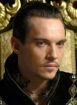  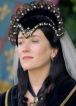  | All of them were Redheads by birth. | |